Lushes Bight, Long Island, NL, has some amazingly picturesque sites, but there is none any more impressive than Back Beach. This locale was regarded as our childhood playground when we were growing up there. The wide variety of activities in which we engaged served us well as physical exercise, enjoyment, and stress reduction. The features of this beach area, located directly out back from our house on the Parsons Point, are almost too many to mention. I will, however, make reference to those which continue to stand out in my memory – those which continue to remind my family members and I of the pleasures of literally having a seashore playground right in our own back yard!
Skipping rocks was one of our most popular pasttimes. Even on Sundays, when we were children, we weren’t really allowed to skip rocks. We bent the rules a little and argued with our parents that we didn’t see much ‘sin’ in that activity. We did, nevertheless, involve competition in the skipping – competing to skip a rock (very flat ones worked the best) the greatest number of times! Sometimes, it was difficulty to count the number of times a rock skipped because at the end of it trail it just seemed to float along the surface until it slowly sank! Many times, we had to calculate the distance it skipped rather than the number of times! There never ever seems to be an argument in the competition! As time passed, Mom and Dad saw that this popular pasttime helped to hold us together as a family and kept us out of trouble, so to speak. A colourful painting by NL artist, Bruce Pilgrim, vividly illustrates this popular childhood activity.
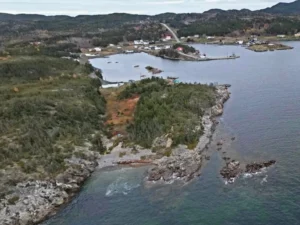
A drone shot (by Ann Heath-Colbourne) of the Parsons Point Back Beach area.
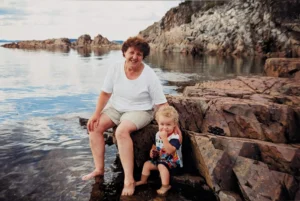
Nanny Betty with grandson Nicholas Henstridge at Back Beach in 19..
Collecting a variety of beach rocks, shells, and driftwood was another enjoyable pasttime. The idea of rock painting goes back much further than 2015 when it was revived as a popular art across the United States and Canada. When we were growing up, my sisters spent time painting them and used these colourful rocks for decorating flower beds and walkways. Shells were either painted, especially mussel and sea urchin shells, or the small ones (like periwinkles and conchs) used to create necklaces or decorative school projects. Even the carapaces of the shoal water crabs, which had collected on the beach, were also used for decorative purposes. Sometimes various types of shells were glued to odd-shaped pieces of driftwood to create a beautiful creation for a lawn or bridge display.

Nick Henstridge, 22 years later with daughter Maisy.

Son, Chris, with his boys Hunter and Luke relaxing after a trek to the beach.
Much of the larger pieces of driftwood that we gathered were used for two specific uses- for our beach boil-ups or for the kitchen stove during the late spring or early fall. We would pile the short pieces of driftwood in a secure spot to create a fire for boiling lobster, crab, mussels, or cooking a pot of fisherman’s brewis.. Being proactive like that would ensure that there would be sufficient fuel ready when we scheduled a boil up. Burning driftwood for home heat during the cooler days of spring and autumn would be a save on regular firewood that was required for the cold days of spring, autumn, and more especially winter. This gathering, piling, and delivering to our home doorplace, while breathing in the unpolluted salt sea air, served us well as our physical exercise.
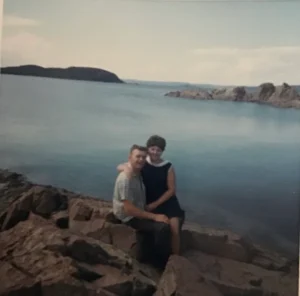
Betty and I enjoy the peaceful seaside surroundings.
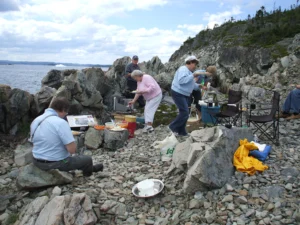
Some family members enjoying a delicious jiggs dinner cooked up ‘on the rocks’ with an iceberg in the distant background.
I remember one of our boil ups was more elaborate than just cooking one thing or the other, like cod or shellfish. It was a full-fledged cook up – a jiggs dinner with all the trimmings. Several family members attended and we ate the meal there on the flatrock section of Back Beach. Oh, yes, we still boiled a pot of mussels for an appetizer. Everything was so delicious! There’s nothing any more gratifying than having dinner cooked on the rocks where the fresh salt sea air energizes you to eat ”til your belly’s full’ – and that we did, for sure!
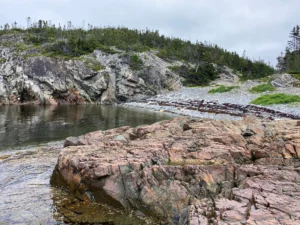
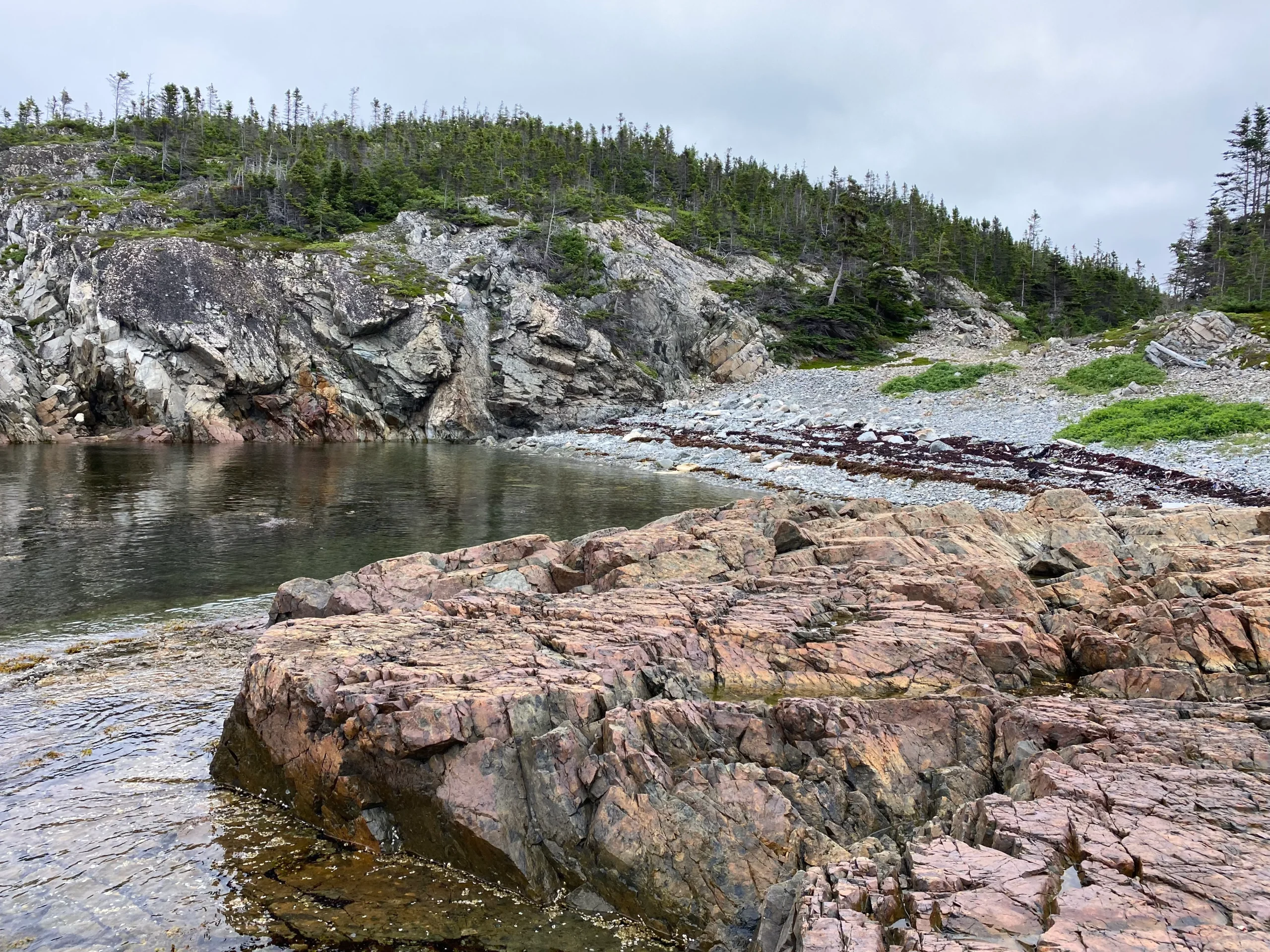
A view of Back Beach looking eastward from the brown flatrocks section of the shoreline.
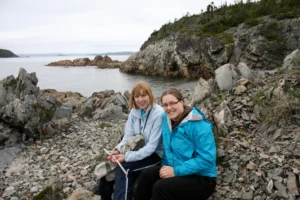
My nieces, Christa and Alana Hudson, visiting the playground from Edmonton, AB.
Back Beach was an ideal observation site to glimpse some of nature’s thrilling and entertaining sights. We’d hide in the bushes just above the beach to view sea gulls and Arctic terns feed there close by. Those familiar with the habits of gulls know that they never dive for their food. If they swim very close to the seashore, however, they will extend their necks under water to reach potential delicacies. Gulls feed primarily on food scattered over beaches; thus, this is why they are referred to as ‘nature’s beach cleaners’. Terns, on the other hand, will dive from high altitudes to secure food. Did you ever see them ‘fishing’? I’m not exactly sure how this works, but they lure small fish closer to the surface by hoovering directly over a fish that they spot and constantly move their wings up and down (without actually moving out of position) until that fish is so close to the surface that the bird is assured of a direct hit! Observing bird antics was not the only way we were entertained. Dolphins and whales also came close to the shoreline in that area. Dolphins are always a pleasure to observe in their constant porpoising through the water. Whales, on the other hand, surface only occasionally, while they are searching for food. From the beach area, we would also make our accent to the back lookout, another higher altitude observation site, where each season offered a wide variety of attractions – Northern rough ice and icebergs with an occasional foundering; the occasional adult seal and white coat; roaring seas and breaking rocks and shoals with a variety of offshore island birds driven in by the strong northeast winds of fall; schooners from the Green Bay area returning from Belle Isle or the Labrador shore loaded with fish; local fishing trapskiffs returning from the trap fishing births and lobster fishermen returning to the harbour with their catch of lobsters; and young sea gulls and terns continuing to train their flying skills.
Another popular activity for both children and adults was daring the swelling tide. We would run to the edge of the tide when it retracked and then run back in an attempt to escape it before it washed over our sneekers. It was amazing to observe how fast this swelling tide can roll back onto the beach. Sometimes we would escape it, and other times it would flood our footwear. Occasionally, we would wear our knee rubbers and change the approach somewhat. We’d walk out into the recessed tide and remain there while the flow was returning, hoping that it would not overflow our rubbers. If it didn’t, we’d get a bit more daring and walk further out into the recessed tide. If we saw that there was a chance that during this attempt that the returning tide would swamp our rubbers, we’d run back towards the beach. Again, sometimes we were fortunate, other time the swelling tide would outwit us! We enjoyed the activity whether our feet were wet or dry at the end of each session!
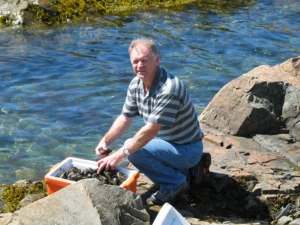
I prepare a cooler of mussels for our appetizer adjacent to my popular lobster-trap setting inlet.
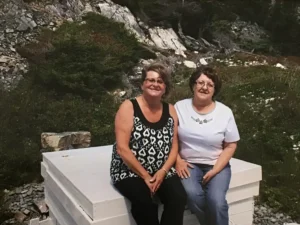
I prepare a cooler of mussels for our appetizer adjacent to my popular lobster-trap setting inlet.
Picking berries was another pasttime at the beach. In particular, we picked blackberries which Mother used for both puddings and cakes. We’d make sure that a sufficuient supply was take to the house so that she could bake one of our favourite desserts topped with her delicious homemade sauce. The upper section of the beach was lined with blackberry bushes and this fruit was readily available to us. Oh, yes, we’d eat a fair share, also. In addition, there was a supply of partridge berries along the path to the beach, but these would not be ripened until late fall. There was also a variety of wild flowers growing amongst the berry bushes and the upper beach rocks. The girls would be sure to pick these to make their own colourful bouquets. I even enjoyed the blue bells that grew there, and I ofter picked them and delivered some to my mother to express my love for her.
We did not have a swimming pool or a body of fresh water close by, but swimming at Bach Beach was always a pleasure. The salt water was always prestine- pollution was unheard of then – and sea water had a greater bouyancy to help in keeping us afloat than fresh water. There were times, of course, when we did take a boat ride to Kelley’s Cove Pond to swim in fresh water. So, again, we incorporated pleasure with physical activity. Whether we swam at Bach Beach or Kelley’s Cove, there was never a life jacket involved. These personal flotation devices were also unheard of back in the late 1940s and throughout the 1950s. Fortunately, while swimming, boating, or fishing, we never encountered a serious incident that was water-related.
The final feature that I will allude to is lobster catching in the cove at Back Beach. There was one inlet of the cove, adjacent to the flat brown-rock section of the beach, which contained fairly deep water and the ideal bottom structure for lobster holes. Sure enough, I always set 3 or 4 traps right in that inlet with a highly successful return. My siblings would walk out to the area to catch a glimpse of me hauling my pots. The flatrock area allowed them to look directly down at the traps before I pulled them aboard my punt. I would encourage them to do this because I knew they could get a sense of whether each pot contained a lobster or two. An obvious sign was when the lobsters’ claws extended through the slatts- sometimes in an attempt to get away from others contained there! Seeing these protruded claws would alone create excitement in the minds of my onlookers! Having a lobster boil later would be even more gratifying! It is not difficult to conclude how much the natural environment at Back Beach meant to my family and me during our childhood and early adulthood days at Lushes Bight. It was a little piece of Heaven located just a stone’s throw away from our doorplace! When Wayne Chaulk, of Buddy Wassisname and the Other Fellers, wote the beautiful song “Salt Water Joys,” he must have had prior experience with my section of Long Island, GBS, NL. Without question, Back Beach provided seaside joys for all members of my family – both young and old alike!